[EXCLUSIVE for Ollie Readers!] 70% off + FREE jerky + FREE Puzzle Toy (it’s back!) Try now!
24 July 2026
10 MINS READ
Beagle: Pros, Cons, and Feeding Guide
Friendly, curious, and famously nose-first! Beagles are incredible family dogs, but managing their appetite is a full-time job. Read our ultimate breed guide covering Beagle pros and cons, common health risks, and how to build the perfect calorie-measured feeding plan.


Reviewed by: Catherine Carchedi, MS, DVM; Lindsay Cassibry, MPH, DVM; and Brittany White, PhD.
What is the best food for beagles?
- Beagles are friendly, sociable, family-loving dogs that get along with kids, other dogs, and most cats, which makes them excellent companions for active households.
- Their biggest care priority is weight. Beagles are one of the most food-driven breeds there is.
- The single most important thing you can do for a beagle is keep them lean and feed them a measured, complete diet.
A beagle leads with their nose. That one fact explains almost everything you will love about the breed, and the handful of things that will test your patience. The same scent drive that makes them charming, curious, and endlessly entertaining is the reason they will unzip a backpack to find a granola bar, and it is why owning a beagle and managing a beagle’s weight turns out to be the same job. This guide covers beagle pros and cons, what is going on under that velvet-eared exterior, and how to feed a beagle so the breed’s biggest health risk never becomes your problem.
See Ollie’s fresh meal plans for beagles →
Beagle quick facts
- Breed group: Hound (scent hound)
- Size: Two varieties recognized by the AKC, one standing under 13 inches, the other from 13 to 15 inches
- Weight: Roughly under 20 pounds for the smaller variety, about 20 to 30 pounds for the larger
- Life expectancy: Around 10 to 15 years
- Coat: Short, dense, low-grooming double coat, classically tricolor (black, white, and tan)
- Temperament: Friendly, curious, merry, sociable, even-tempered [1]
- Best known for: A world-class nose. Beagles work as detection dogs in the USDA and U.S. Customs and Border Protection program that sniffs out prohibited food and agricultural products [2]
Pros of owning a beagle
- Beagles are wonderful family dogs. Bred to hunt in packs, they are wired to live alongside others, which translates into a dog that is genuinely happy to be part of the group, whether the group is two people or a full house of kids, cats, and fellow dogs [1].
- They are sociable to their core. A beagle is not a one-person dog who tolerates everyone else. They tend to greet new people, new dogs, and houseguests as potential friends.
- They are low-maintenance in the grooming department. That short, weather-ready coat needs little more than a weekly brush and the occasional bath. Those long, floppy ears do need regular checks and cleaning, though.
- They are compact and adaptable. A 20-something-pound dog fits a lot of lives, doing well in apartments and houses, city and country, as long as they get real daily exercise.
- They are up for anything. Hikes, fetch, a long sniffy walk, a romp with other dogs at the park. Beagles bring a cheerful, game-for-it energy that makes them a great match for active people and families.
Cons of owning a beagle
- They are vocal. Beagles bark, and they bay, that distinctive drawn-out hound howl. It is part of the charm for many owners and a genuine consideration if you have close neighbors or thin walls.
- They dig. A beagle who catches an interesting scent at the fence line may decide to excavate it, especially if left alone too long.
- They are independent thinkers. A beagle’s nose outranks your voice, so once they are locked onto a scent, recall gets unreliable fast. Positive, food-motivated training works well here.
- They are relentless about food, a trait that shapes everything about feeding and long-term health (more on that below).

Beagle temperament: the nose-first dog
Everything about a beagle’s personality routes back through that remarkable nose. They are scent hounds, bred over centuries to pick up a trail and stay on it for hours, and that hardware did not switch off when they moved from the hunt to the couch.
In practice, the nose-first wiring shows up as selective hearing, a powerful pull to roam, and a talent for finding food you were certain was out of reach. Counter-surfing, trash-investigating, and backpack-raiding are not bad behavior so much as a beagle doing exactly what a beagle was built to do.
The upside of all that drive is a dog who is curious, engaged, and a joy to keep busy. Scent games, snuffle mats, food puzzles, and “find it” work are irresistible to a beagle, and they double as a way to feed the brain without overfeeding the body. A beagle thrives in company and struggles with long stretches alone, where boredom curdles into barking, digging, and destruction.
Beagle health and common issues
Beagles are, on the whole, a sturdy and long-lived breed, which is part of why they have stayed so popular. But like every breed, they come with a few known predispositions worth knowing about [2]:
- Weight gain and obesity. The defining health risk of the breed, and the one most directly in an owner’s control. Beagles have a well-documented tendency toward obesity, and their food intake needs to be actively managed rather than left to appetite [2][3].
- Ear infections. Those signature low-set, floppy ears reduce airflow to the ear canal, creating a warm, moist environment where yeast and bacteria can flourish. Weekly ear checks go a long way.
- Hypothyroidism. An underactive thyroid can show up as weight gain, low energy, and coat changes, and is typically manageable with medication once diagnosed.
- Eye conditions. Beagles can be prone to cherry eye and glaucoma, both worth flagging to your vet if you notice redness, swelling, or cloudiness.
- Epilepsy. The breed has a recognized predisposition to idiopathic epilepsy, often well controlled with veterinary care.
- Joint and back health. Hip dysplasia and intervertebral disc issues can occur, and carrying extra weight makes any joint or spinal vulnerability worse [2].
The throughline across most of this list is bodyweight. Keeping a beagle at a healthy weight is one of the highest-leverage things an owner can do for the breed’s long-term health and comfort.
How much should a beagle weigh? (And why it matters)
A healthy beagle generally lands under about 20 pounds for the smaller variety and in the 20-to-30-pound range for the larger one [1]. But the number on the scale matters less than what you can feel with your hands, because two beagles of the same height can carry very different amounts of fat.
The tool vets use is body condition scoring, and you can do a quick version at home:
- Ribs: You should be able to feel the ribs easily with light pressure, the way you can feel the back of your hand. If you have to press to find them, there is too much padding.
- Waist: Looking down from above, there should be a visible waist that tucks in behind the ribs. A straight or bulging outline from above is a sign of extra weight.
- Tuck: From the side, the belly should rise up toward the back legs, not hang level with the chest.
This matters because beagle weight management is not a vanity project. Beagles are food-motivated enough that they are used as a model in canine obesity and metabolism research. Excess weight is linked to a longer list of problems, from joint strain to metabolic issues, that can shorten a dog’s good years, according to a study published in 2022 [5]. The encouraging flip side: weight is the one major beagle health lever that is almost entirely in your hands.
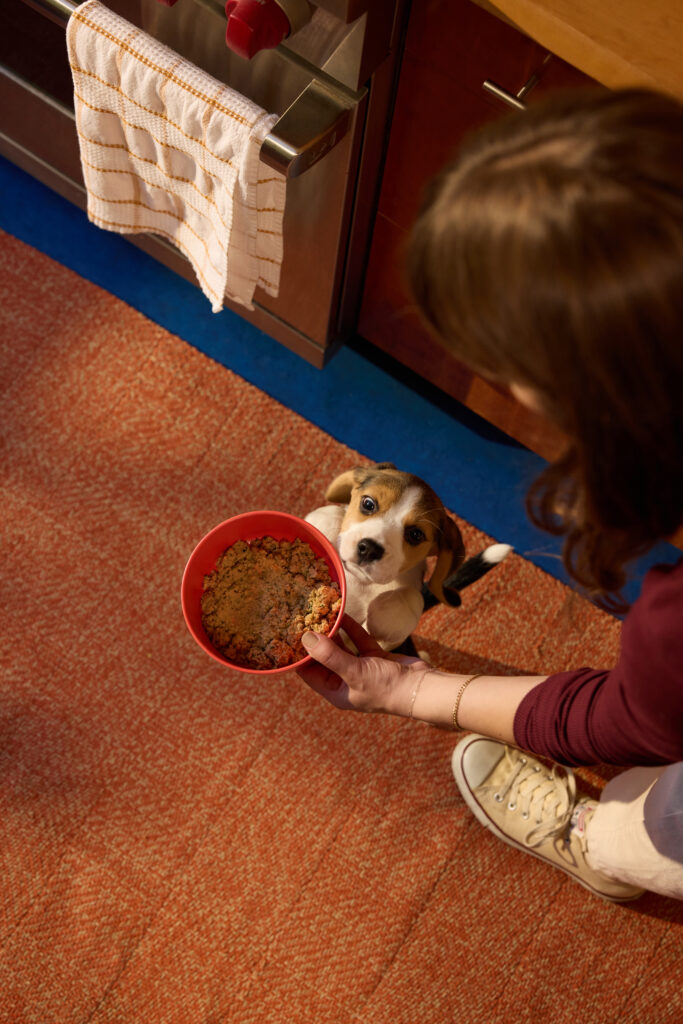
Beagle nutritional needs
A beagle diet should do three jobs at once: deliver complete, balanced nutrition, satisfy a serious appetite without overdelivering calories, and stay consistent enough that you can actually tell how much your dog is eating.
Here’s what that looks like in practice:
- Quality protein as the foundation, to support lean muscle on an active, compact body.
- Calorie awareness above all, because the gap between “enough” and “too much” is small on a dog this size. A few extra treats a day add up far faster on a 22-pound beagle than on a 70-pound Lab.
- Lasting satiety, so a hungry dog feels fed. Whole-food ingredients and adequate protein and fiber help a beagle feel satisfied on an appropriate number of calories.
- Measured meals, not free-feeding. A bowl left out all day is an open invitation that a beagle will accept every time.
Research published in 2025 on food motivation has found that how strongly a dog is driven by food, paired with how closely owners manage feeding, tracks with whether that dog ends up overweight [4]. For a breed that scores near the top on food drive, that finding is basically a beagle owner’s manual: the food itself, and your discipline around it, do most of the work.
Build your beagle’s perfectly portioned plan →
How much to feed a beagle
Because every dog is different, there is no set number of calories to feed your beagle. The right amount depends on your beagle’s life stage (puppies need more calories per pound and more frequent meals to fuel growth), size, and activity level.
A calorie-measured plan is the obvious answer for a dog like this. Instead of scooping cups and guessing, you feed a known number of calories matched to your beagle’s weight, spay/neuter status, and activity, then adjust to body condition. Ollie’s plans work exactly this way: portions are calculated for your specific dog rather than estimated by you.
What is the best dog food for beagles?
The best food for beagles is not a single product, but instead a set of qualities. Here’s what to be on the lookout for when scouting for dog food for your beagle:
- Complete and balanced nutrition appropriate to your beagle’s life stage.
- Real, recognizable ingredients with quality protein doing the heavy lifting.
- Built-in portion control, which for this breed is essential.
- Calorie transparency, so you know exactly what is going in the bowl.
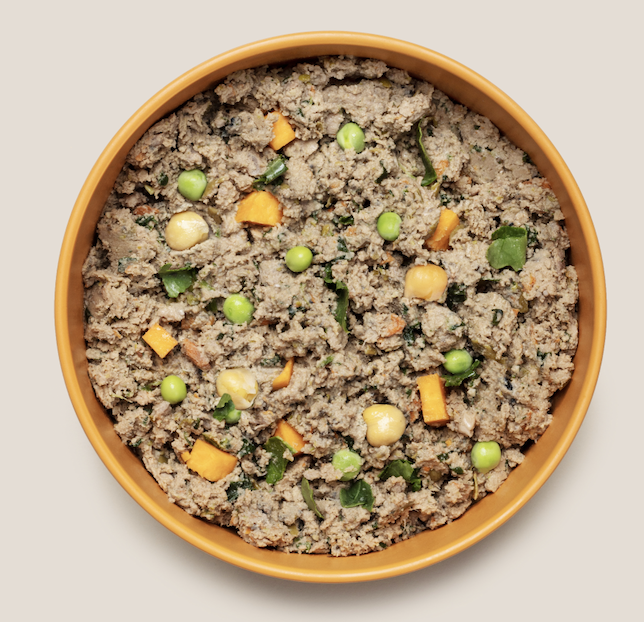
This is where fresh, pre-portioned food has a particular advantage for beagles. Ollie’s recipes are crafted with chefs and veterinary nutritionists, made with human-grade ingredients, and portioned to each dog’s exact calorie needs, which directly solves the breed’s number-one problem: it removes the daily judgment call that a food-motivated beagle is so good at exploiting.
A beagle who is fed well and kept lean is a beagle set up for a longer, more comfortable, more active life. That is the most meaningful thing nutrition can do for the breed.
Start your beagle’s fresh food plan →
FAQs about beagles
Q: Are beagles prone to obesity?
A: Yes, more than most breeds. Beagles have a strong, well-documented tendency toward weight gain, driven by an unusually high food motivation, and their intake needs to be actively managed [2][3]. The good news is that it is highly preventable with measured meals, treat discipline, and regular exercise.
Q: What is the best dog food for a beagle?
A: A complete, balanced, life-stage-appropriate food made with quality ingredients and, crucially for this breed, one that makes portion control easy. Fresh, pre-portioned meals like Ollie’s are well-suited to beagles because they are calorie-measured to each dog.
Q: Is fresh food good for beagles?
A: Yes. Beyond precise portioning, fresh food like Ollie’s uses quality ingredients and protein that help a beagle feel satisfied on an appropriate number of calories, which makes the breed’s constant food-seeking far easier to manage.
Q: How much should I feed my beagle per day?
A: Enough to maintain a lean body condition, which varies with age, size, and activity rather than landing on one universal number. Use body condition (easily felt ribs, a visible waist, a belly tuck) as your guide, keep treats to roughly 10% of daily calories, and feed measured meals instead of free-feeding.
Q: Do beagles have digestive problems?
A: Beagles are not an especially sensitive-stomach breed, but their habit of eating things they find (trash, counter scraps, mystery objects on walks) lands plenty of them in dietary trouble. A consistent, high-quality diet and keeping food and garbage genuinely out of reach prevent most issues.
Q: Are beagles picky eaters or food-motivated?
A: They are famously food-motivated, and near the very top of the scale. Picky is rarely the problem with a beagle. That enthusiasm is a gift for training but a liability for the waistline, so the goal is to channel it rather than indulge it.
Q: What human foods are dangerous for beagles?
A: The same foods that are toxic to all dogs, and a determined beagle nose makes accidental exposure more likely. Keep chocolate, grapes and raisins, onions and garlic, xylitol, macadamia nuts, and alcohol well out of reach. If your beagle gets into any of these, contact your vet or a pet poison helpline right away.
Q: Do beagles need a special diet for their nose or scent work?
A: No, there is no special “scent food.” What actually supports a working or playing nose is the same thing that supports the whole dog: complete, balanced nutrition and a healthy weight.
References and further reading
- American Kennel Club. Beagle Dog Breed Information. https://www.akc.org/dog-breeds/beagle/
- Encyclopaedia Britannica. Beagle | Overview, Lifespan, Health, History & Temperament. https://www.britannica.com/animal/beagle-dog
- Pegram, C., et al. (2021). Frequency, breed predisposition and demographic risk factors for overweight status in dogs in the UK. Journal of Small Animal Practice. https://onlinelibrary.wiley.com/doi/10.1111/jsap.13325
- Montoya, M., et al. (2025). Food motivation and owner feeding management practices are associated with overweight among Dog Aging Project participants. American Journal of Veterinary Research. https://avmajournals.avma.org/view/journals/ajvr/86/5/ajvr.24.11.0358.xml
- A protein- and fiber-rich diet with astaxanthin alleviates high-fat diet-induced obesity in beagles. PMC. https://pmc.ncbi.nlm.nih.gov/articles/PMC9637869/
The Ollie blog is devoted to helping pet parents lead healthier lives with their pups. If you want to learn more about our fresh, human-grade food, check out ollie.com. Marissa Taffer also contributed to this article and it was expertly reviewed by: Catherine Carchedi, MS, DVM; Lindsay Cassibry, MPH, DVM; and Brittany White, PhD.
Disclaimer: This article and the Ollie blog is for informational purposes only and is not a substitute for professional veterinary advice, diagnosis, or treatment. If your dog is showing signs of illness and/or injury, always consult your veterinarian promptly. Every dog is different, and any dietary change should be discussed with your veterinarian. Ollie is not a prescription or therapeutic diet and is not intended to prevent, treat, or manage any medical condition. Always work with your vet to determine the best care plan for your individual pup, especially if they’ve been diagnosed with a health condition.
Tagged As:

The nutrition your dog needs,
the food they want.
Written by:
Elizabeth Wieck is a New York City–based writer and consultant with more than a decade of experience. She loves telling stories that connect with readers—especially when they involve pets.




Enjoying our articles? Subscribe our Newsletters and get new articles directly to your inbox
You might also like

30 August 2026
13 MINS READ
Chihuahua: Pros, Cons, and Diet Guide
The Chihuahua packs huge personality into a tiny frame. Learn about Chihuahua pros and cons, temperament, key health concerns, and expert feeding tips.

25 August 2026
10 MINS READ
Shih Tzu: Pros, Cons, and Best Food Guide
Thinking about bringing home a Shih Tzu? This guide breaks down the breed’s personality, grooming needs, and whether it’s the right fit for your life.

25 August 2026
10 MINS READ
Golden Retriever: Pros, Cons, and Diet Guide
Golden retrievers are famously friendly, but they come with unique needs—from heavy shedding to significant health risks like cancer. Discover the pros, cons, and how the right diet supports your…